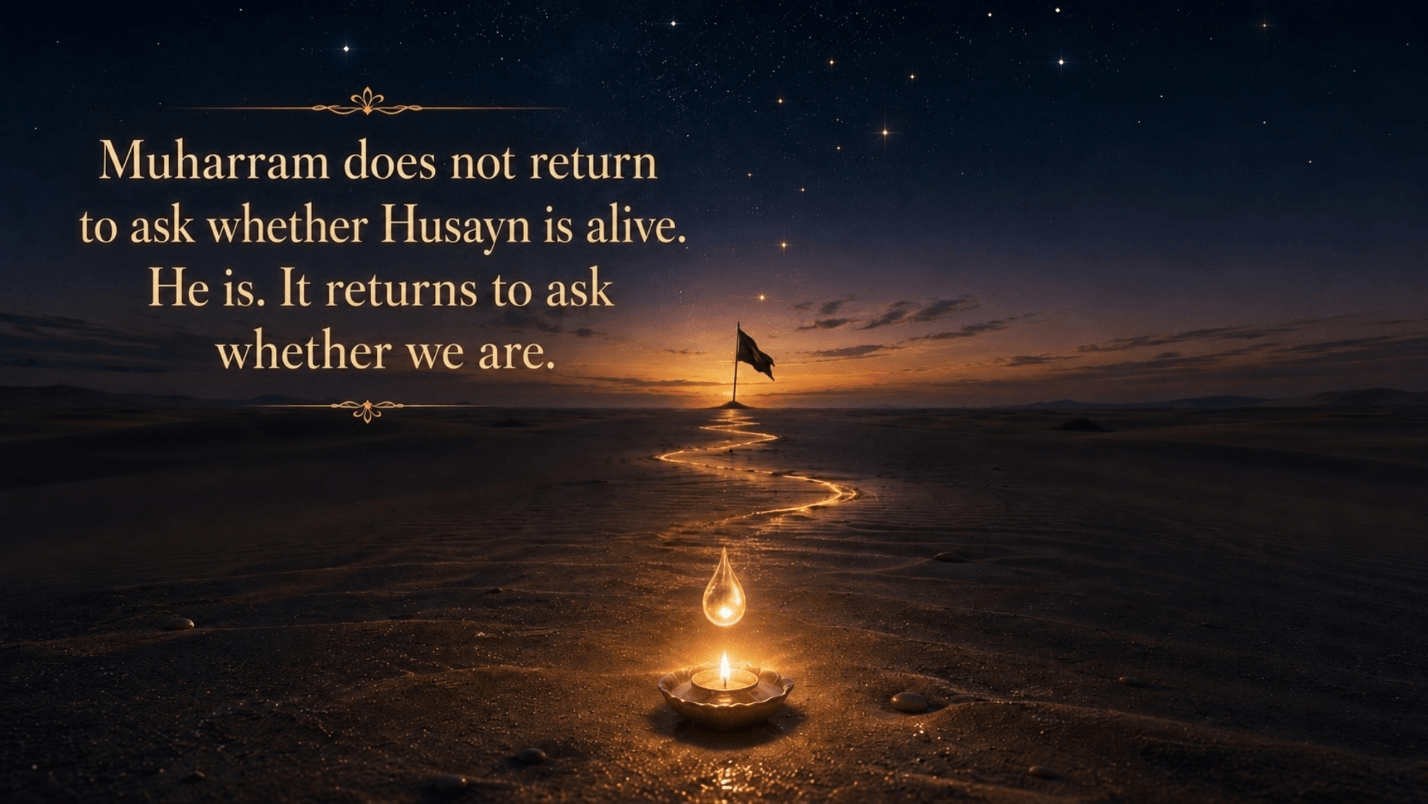
If our tears do not make us more truthful, then perhaps they have not yet become Karbala’s tears. They are still only water.
As the Islamic new year begins, the heart begins to hear an old summons.
Muharram is not simply mourning. Not merely the rhythm of majlis, marsiya, noha, and tears.
These sacred forms carry memory, gather the community, and teach the next generation that remembrance is not nostalgia. It is inheritance. It is witness. It is the refusal to let truth disappear into history’s dust.
But beneath them is something deeper.
A question.
A wound.
A mirror.
Every year, Karbala returns.
Or perhaps Karbala never left.
We are the ones who drift away. We become busy. We become practical. We become respectable. We learn to make peace with compromise. We develop careful language for silence: strategy, balance, timing, neutrality. Humanity has always known how to give cowardice a respectable vocabulary.
Then Muharram arrives.
And the desert speaks again.
It asks whether we still know the difference between life and survival. Between patience and surrender. Between peace and silence. Between faith and performance.
Karbala is not only a tragedy remembered.
It is a truth repeated.
It returns because power still demands obedience. It returns because injustice still dresses itself in religious language, political necessity, and public order. It returns because the innocent are still denied water, safety, dignity, and voice while the comfortable debate procedure.
And so we return to Husayn (as).
Not because he needs our tears.
We need his clarity.
Iqbal and the Meaning of Grief
Allama Iqbal’s poem “Falsafa-e-Gham,” included in Bang-e-Dara, offers one of Urdu poetry’s most profound meditations on sorrow.
For Iqbal, grief is not mere sadness. It is not emotional collapse. It is not weakness. It is not the opposite of life.
Grief is part of life’s hidden architecture.
He writes:
ہے ‘الم’ کا سورہ بھی جزوِ کتابِ زندگی
Hai ‘alam kā sūrah bhī juzv-e-kitāb-e-zindagī
The chapter of sorrow, too, belongs to the book of life.
Karbala is the chapter of pain in the book of Islam. But it is not a chapter of defeat. It is the chapter that teaches every other chapter how to be read.
Without Karbala, courage becomes theory.
Without Karbala, justice becomes slogan.
Without Karbala, love becomes sentiment.
Without Karbala, faith becomes decoration.
Karbala gives these words purified blood.
Iqbal does not ask us to run from grief. He asks us to understand it. Sorrow, for him, is not merely something that wounds the heart. It is something that reveals the heart.
Grief as Awakening
Iqbal’s philosophy of grief is not gloomy. He does not romanticize pain. He does not pretend that wounds are beautiful in themselves.
He says something more difficult.
Sorrow can deepen the human being.
Pain, when joined with faith and insight, can polish the soul.
He writes:
حادثاتِ غم سے ہے انساں کی فطرت کو کمال
غازہ ہے آئینۂ دل کے لیے گردِ ملال
Hādisāt-e-gham se hai insāñ kī fitrat ko kamāl
Ghāzah hai ā’īna-e-dil ke liye gard-e-malāl
Through the shocks of grief, human nature reaches perfection;
the dust of sorrow becomes fragrance-infused powder for the mirror of the heart.
Dust should cloud a mirror. Iqbal makes it polish one.
That is Karbala.
The grief of Karbala does not darken the heart. It cleans it. It removes the fog of comfort. It allows us to see tyranny as tyranny, courage as courage, and faith as something greater than inherited belonging.
To remember Husayn (as) is to remove impurities from the heart and fill your heart with the fragrance of Ahl al-Bayt. It will keep your conscience shining like a mirror.
And sometimes the mirror shows us things we would rather not see: our compromises, our silence, our selective outrage, our habit of mourning the dead while ignoring the living.
Iqbal then gives grief wings:
طائرِ دل کے لیے غم شہپرِ پرواز ہے
راز ہے انساں کا دل، غم انکشافِ راز ہے
Tā’ir-e-dil ke liye gham shahpar-e-parwāz hai
Rāz hai insāñ kā dil, gham inkishāf-e-rāz hai
For the bird of the heart, grief is the wing of flight;
the human heart is a secret, and grief is the unveiling of that secret.
Grief does not have to pull the heart downward. When joined to truth, it gives the heart wings.
Some grief imprisons. Some grief turns bitter. Some grief collapses inward. The grief of Karbala is different because it does not end in despair. It rises into witness, victory, and eternal life.
The sorrow of Husayn (as) reveals what lies hidden within us.
Do we love truth only when it is safe?
Do we stand with justice only when it is popular?
Do we mourn oppression in history while explaining it away in the present?
Karbala reveals us to ourselves. If you will look at yourself in the mirror of Karbala, you will see your inner self. Your conscience will start guiding you instead of your desires.
That is why living truth-tellers are harder to honor than dead martyrs. The dead ask for memory. The living ask for courage.
The Sorrow of Karbala
Karbala was not a performance.
Imam Husayn (as) did not stand in Karbala to create a culture of sadness. He stood to defend truth and injustice from being bulldozed by power. He stood so that Islam would not become the private property of rulers. He stood so that obedience to corruption would not be mistaken for loyalty to religion.
At the heart of Karbala was Husayn’s refusal to bow in front of a tyrant.
He refused bay‘ah to a ruler whose authority would have emptied Islam of its moral soul. He denied humiliation. He denied false legitimacy. He denied letting silence become complicity.
The sorrow of Karbala is unlike ordinary sorrow.
Ordinary grief mourns what has been lost.
Karbala mourns what must never be lost again.
It mourns Ali Asghar, the infant whose thirst exposed the cruelty of power without disguise.
It mourns Abbas, who reached the water but would not drink while the tents of Husayn remained thirsty.
It mourns Qasim, the young seeker of martyrdom, whose youth became testimony.
It mourns Ali Akbar, whose beauty and courage carried the echo of the Prophet’s household.
It mourns the companions who chose loyalty when survival was still available.
It mourns Husayn, who stood almost alone, yet was never morally outnumbered.
But Karbala’s grief does not end at the grave.
It becomes protest.
It becomes memory.
It becomes conscience.
It becomes that strange fire which allows the oppressed to say: we may be crushed, but we will not be owned.
Karbala transforms death into eternal life.
This is why the grief of Husayn (as) has survived empires.
Armies passed. Thrones collapsed. Palaces became dust.
But the name of Husayn (as) remained.
Yazid won the battlefield.
Husayn (as) won the human heart.
That is the verdict history could not overturn.
Love Does Not Die
Iqbal then turns from grief to love. For him, grief is not separate from love. Grief is love continuing after separation.
He writes:
عشق کچھ محبوب کے مرنے سے مر جاتا نہیں
روح میں غم بن کے رہتا ہے، مگر جاتا نہیں
Ishq kuch mahbūb ke marne se mar jātā nahīñ
Rūh mein gham ban ke rehtā hai, magar jātā nahīñ
Love does not die when the beloved dies;
it remains in the soul as grief, but it does not depart.
This is the secret of Karbala.
Imam Husayn (as) was killed. But love for Husayn did not die.
It entered the soul of the ummah as grief.
It remained there.
It refused to leave.
It became poetry.
It became resistance.
It became a civilization of memory.
But love that remains only emotion is incomplete.
Love must become recognition.
To love Husayn (as) is to recognize what Husayn stood for. To mourn Husayn is to understand what he refused.
He refused humiliation. He refused corruption dressed as authority. He refused to bless injustice with silence. He refused to allow religion to become the servant of power.
Because love does not die.
It has grown into passion and a movement. It has intensified generation after generation for the past fifteen centuries.
The Martyrs Are Not Gone
Iqbal writes:
مرنے والوں کی جبیں روشن ہے اس ظلمات میں
جس طرح تارے چمکتے ہیں اندھیری رات میں
Marne wāloñ kī jabīñ roshan hai is zulmāt mein
Jis tarah tāre chamakte haiñ andherī rāt mein
The brows of the dead shine in this darkness,
just as stars glitter in the dark night.
This is the heart of Karbala’s immortality.
Their bodies were left on the sands, but their meaning entered the conscience of the world. Husayn was separated from us in time, but never in truth.
He remains present wherever power is challenged by principle.
Wherever grief refuses to become despair. Wherever memory becomes resistance. Wherever the weak refuse to sell their dignity for survival.
Karbala is not locked in 680 CE. It is not safely buried in the past, where it can inspire us without disturbing us.
Karbala is a living measure.
It asks every generation: where do you stand when truth is costly?
This is why the martyrs are not gone.
They are lights in our darkness.
Ali Asghar shines as innocence.
Abbas shines as loyalty.
Qasim shines as youthful devotion.
Ali Akbar shines as beauty offered to truth.
The companions shine as chosen fidelity.
And at the center of that night stands Husayn (as), the lamp that refuses extinction.
Their deaths are not endings.
They are stars.
Muharram and Us
So as Muharram comes near once again, we must ask ourselves: what are we preparing for?
A season of remembrance? Yes.
A season of tears? Yes.
A season of loyalty? Yes.
But also a season of moral examination.
What does it mean to mourn Husayn (as) in a world still full of thirst?
The thirst of Karbala was not only the thirst of bodies. It was the thirst of justice in a world that had forgotten shame.
What does it mean to beat our chests if our hearts remain unmoved by suffering?
What does it mean to curse Yazid while quietly imitating his logic: power first, truth later?
Karbala does not permit us to mourn thirst in the desert while ignoring thirst at our doorstep.
Karbala speaks wherever children are denied water, safety, and shelter. It speaks wherever the oppressed are humiliated by power. It speaks wherever truth-tellers are silenced. It speaks wherever religious language is used to protect authority instead of purifying it. It speaks wherever communities mourn beautifully but act timidly.
Muharram is not a performance of grief. It is a discipline of conscience.
It teaches us that sorrow is not the opposite of strength. Sometimes sorrow is the only honest form strength can take.
To weep for Husayn is not to escape the world.
It is to re-enter it with clearer eyes.
The tears of Karbala are not private emotion alone. They are public memory. They are resistance against forgetfulness. They are the refusal to let tyranny control the story.
Iqbal gives us the philosophy.
Karbala gives us the proof.
Zaynab (sa): When Grief Became Speech
No reflection on Karbala’s grief is complete without Sayyida Zaynab (sa). If Husayn showed how to die for truth, Zaynab (sa) showed how to carry truth after devastation.
Karbala did not end on the battlefield.
That is one of the great mistakes in reading Karbala. The swords fell silent, but the message had not ended. It moved to Kufa. It moved to Damascus. It entered the courts of Ibn Ziyad and Yazid. It stood before power without apology.
Zaynab (sa) transformed captivity into testimony.
Her grief did not silence her.
It sharpened her.
In Kufa, she spoke to a people who had failed to stand when standing mattered. In Damascus, she confronted the arrogance of power and refused to let Yazid define the meaning of Karbala.
This is the power of sacred grief.
It does not merely remember.
It interprets.
It judges.
It exposes.
It preserves truth.
Yazid could parade captives. He could display victory. He could mistake force for triumph, as rulers have done in every age when power confuses itself with truth.
But Zaynab (sa) gave Karbala its voice.
The empire thought the battlefield had ended the story. Then Zaynab (sa), daughter of Ali (as), stood before tyrants and spoke.
Through her fearless khutbas, Karbala entered the conscience of history. Because of her, the message of Husayn (as) was not buried. Because of her, we still speak.
Without Zaynab (sa), Karbala might have been buried by the empire.
Instead, Zaynab (sa) buried the empire.
The Sorrow That Refuses to Die
Iqbal helps us understand why grief can be sacred.
Karbala shows us what sacred grief looks like in history.
It is grief with direction.
Grief with dignity.
Grief with moral fire.
Grief that does not collapse into despair, but rises into witness.
The world tells us to avoid sorrow. Karbala tells us to listen to the right sorrow. The sorrow that purifies. The sorrow that awakens. The sorrow that keeps us human in an age that often rewards becoming something less.
As Muharram approaches, perhaps the question is not simply whether we will mourn.
We will.
We know how to mourn.
The harder question is whether mourning still knows how to change us.
Will it make us braver? Will it make us more truthful? Will it make us less willing to bow before the idols of comfort, ego, tribe, and power?
Because Karbala does not ask for tears alone. It asks what those tears have awakened. And if nothing has awakened, then perhaps we have not yet understood grief. We have only decorated it.
Karbala is the sorrow that refuses to die because conscience must not die. Husayn’s blood did not sink into the desert. It rose into history. It became a lamp. It became a cry. It became the standard by which every age must measure its courage.
Muharram does not return to ask whether Husayn is alive.
He is.
It returns to ask whether we are.
Iqbal has profoundly positioned the trajectory for us to see where we fit in:
غریب و سادہ و رنگیں ہے داستانِ حرم
نہایت اس کی حسینؑ، ابتدا ہے اسماعیلؑ
The story of the Sacred House is simple yet profound;
It begins with Ishmael and reaches its culmination in Husayn.

Comments