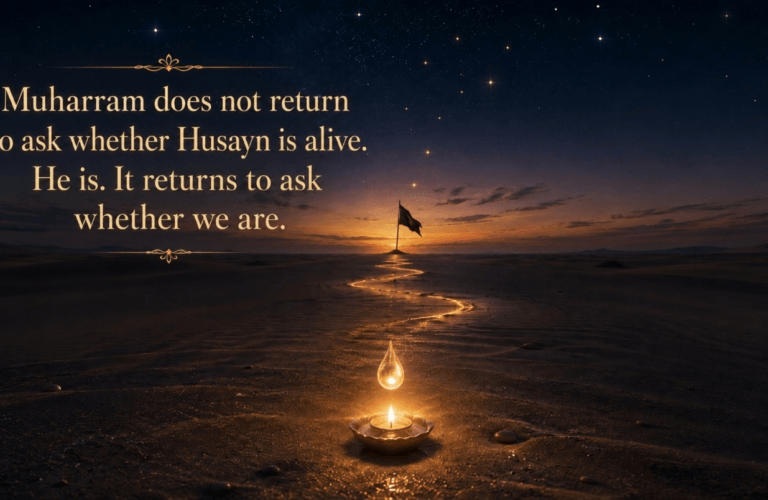
Why do we attend these Majalis every single year during Muharram? Didn’t these events take place over 1,400 years ago?
Yet, what fascinates the mind is that this history continues to echo through time. Each year, a new reflection finds its way into our hearts, awakening souls that have grown weary, distracted, and consumed by the endless noise of social media.
Our scholars often say in Urdu, “Majlis-e-Hussain dil ki kheti hai” – meaning that the ‘’Majlis of Imam Hussain is the cultivation of the heart’’.
Just as a flourishing garden begins with a seed, our hearts are first prepared through marsiya, soz, and salam, creating fertile ground for that seed to take root. The nourishment comes through listening attentively to the Majalis, allowing their lessons to strengthen faith and deepen understanding. Then come the tears shed in remembrance of Imam Hussain (a.s.), drops that water this spiritual garden, enabling it to grow from a tender seedling into a flourishing plant, and eventually into a mighty tree. The sweetest fruits of this tree are not words alone, but righteous deeds (a’mal-e-ṣaliḥ). When the lessons we hear are transformed into action, they become a living legacy, inspiring and guiding the generations that follow.
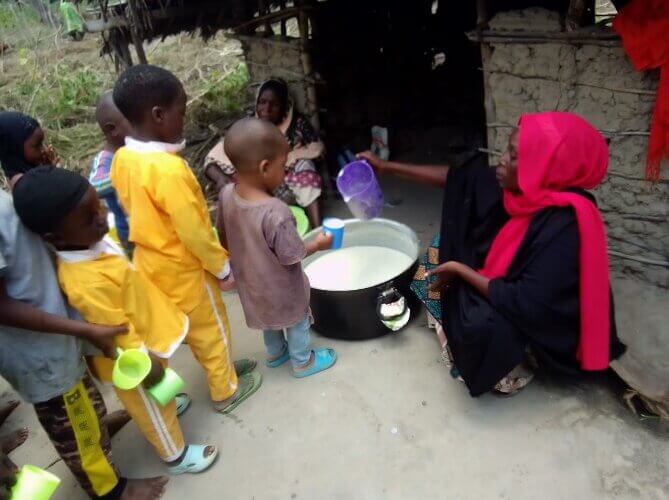
According to our revered Maraji al-Kiram, one should always be generous in supporting every noble cause connected to Azadari. Even if one’s personal expenses increase, one’s financial contribution towards Azadari should never be compromised.
One must reflect on why Imam Husain (a.s.) departed from Makkah for Karbala, converting his Hajj into an Umrah. His decision conveyed a profound message: his mission was not merely a journey, but one of islaḥ (reformation), to preserve the true teachings of Islam and uphold the Oneness of Allah (Tawḥid). Rather than allowing bloodshed to occur within the sanctity of the Holy City, Imam Husain (a.s.) chose to leave Makkah, safeguarding the message of Islam over personal safety.
Many of us may not yet fully comprehend the depth of this movement, but its lessons remain timeless. The struggle between truth and falsehood did not end in Karbala. In many ways, we continue to live through our own ‘Micro-Karbalas’ today, where faith, justice, and moral conviction are tested in different forms.
Let us first pause and ask ourselves a simple question: Am I truly poor, or am I truly rich?
Most of us would instinctively think of the dreams we have yet to fulfil, the wealth we still hope to earn, and the comfort, luxury, and peace we continue to pursue. Such thoughts are only natural.
It is narrated that a man once approached Imam Ali (a.s.), complaining that he was poor. The Imam asked him, “Are you certain that you possess nothing?”
The man replied with complete confidence, “Yes.”
Imam Ali (a.s.) then said, “If you truly desire the wealth, power, and possessions of this world, then exchange the love for us that resides in your heart for them.
“The man was overcome with astonishment and replied, “How could I ever do such a thing? By Allah, I would never even think of trading my love for you and your family, O Imam.”
The true wealth of a believer does not lie in material possessions, but in the priceless gift of Wilayah. A heart illuminated by Wilayah possesses a treasure that no worldly fortune can equal. Without Wilayah, a person loses sight of life’s true purpose. With it, however, one possesses a wealth that neither time nor circumstance can diminish. This is why, in the truest sense, the believer who cherishes Wilayah is ‘’Ghani’’ (truly wealthy), regardless of what he or she owns in this world.
Today, we owe our allegiance to our living Imam, Imam al-Mahdi (a.t.f.s.), who may be hidden from our eyes but is never absent from our lives. He sees our actions, our intentions, and our struggles. Perhaps our Imam is still searching for a “Hurr” among us. Someone willing to repent, transform, and answer the call of truth. Perhaps to put it more deeply, one of us may strive to become worthy of being counted among his 313 loyal companions.
Some may ask: ‘’If we are unlikely to be among the 313, why should we continue to pray for the Imam’s ATFS reappearance?’’
The answer is simple. None of us knows how much life Allah has granted us. What we can control is our effort to become sincere believers who long for the Imam’s return, live by his teachings, and prepare ourselves to support his mission. By doing so, we will at least never regret having neglected our duty toward our Imam. Rather, we hope to be counted among his helpers and supporters, whether during his reappearance or through the sincerity of our intentions before Allah. Is there any greater honour than this?
We often say, “Had we been in Karbala, we would have stood beside Imam Husain (a.s.).” But the real question is not what we would have done then? It is what we are doing now!
The struggle between truth and falsehood did not end on the plains of Karbala; it continues in every generation, echoing through every age and society.
Where do we stand in this struggle? What role are we playing?
Some may say: “This is not our war. It is someone else’s.”
No. Whenever truth stands against oppression, the responsibility of every believer begins. We cannot claim to love Imam Husain (a.s.) while remaining indifferent to injustice. We cannot profess loyalty to Imam al-Mahdi (a.t.f.s.) while ignoring the suffering of the Muslim Ummah and the pain that weighs upon the heart of our living Imam.
If our hearts no longer feel the suffering of the oppressed, if they no longer yearn for justice or long for the reappearance of the Imam (a.t.f.s.), then we must sincerely ask ourselves whether we have remained faithful to the covenant of Wilayah.
Karbala calls us not only to mourn, but to awaken, to reform ourselves, and to stand with truth wherever it may be found.
Remembering Karbala is only the beginning. Its true legacy is reflected in hearts that give freely, trust Allah completely, and expect nothing but His pleasure.
Written by Sakeena Habib (Writer, Media & Pyschology Journalist / Lecturer)

Comments